This post contains affiliate links.
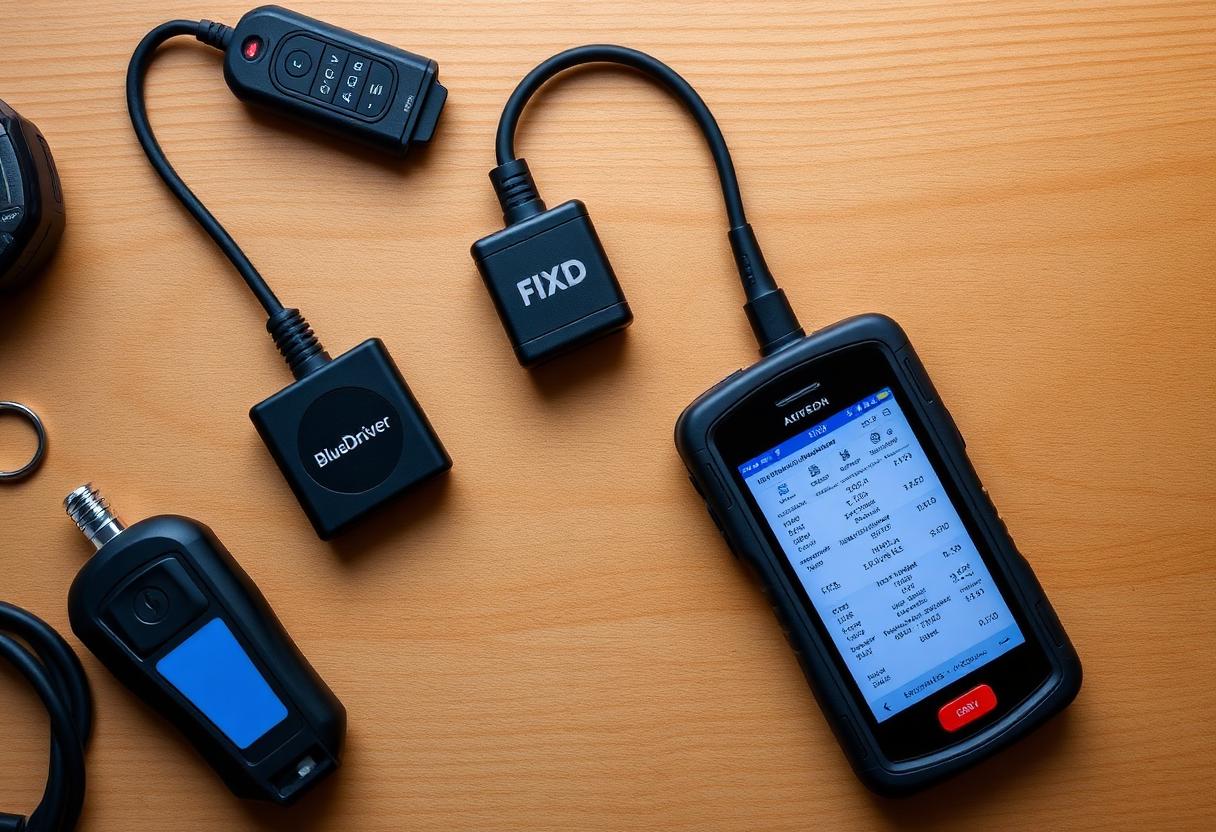
If you’re a DIY car owner, a good OBD2 scanner can save you time and money by reading and clearing trouble codes like P0420 or P0442, checking smog readiness, and even performing advanced diagnostics. But with so many options, choosing the right one can be tough. In this guide, we compare three popular choices: BlueDriver, FIXD, and Autel (handheld models like the MaxiCOM or AutoLink). We’ll look at price, features, subscriptions, and ease of use to help you pick the best scanner for your needs.
Comparison Overview
| Feature | BlueDriver Bluetooth Pro | FIXD Sensor + App | Autel Handheld (e.g., AutoLink AL619) |
|---|---|---|---|
| Price (approximate) | $100–$120 | $30–$60 (sensor) + subscription | $80–$300+ depending on model |
| Hardware Type | Bluetooth dongle | Bluetooth dongle | Handheld unit with screen |
| Subscription Required? | No | Yes (monthly or yearly) | No |
| Live Data | Yes (up to 6 parameters at once) | Limited (premium subscription) | Yes (multiple parameters) |
| Freeze Frame | Yes | Yes (basic) | Yes |
| Bidirectional Control | No | No | Some models (e.g., MaxiCOM) |
| ABS / SRS / Transmission | Yes (enhanced diagnostics) | No (basic only) | Yes (on higher-end models) |
| Smog Readiness / I/M Readiness | Yes | Yes (premium) | Yes |
| Repair Reports | Yes (free with app) | Yes (premium) | No (code definitions only) |
| Ease of Use for Beginners | Very easy (app-guided) | Very easy (simple app) | Moderate (menu-driven) |
| Best For | DIYers who want advanced features without subscription | Beginners on a tight budget | DIYers who prefer standalone unit and advanced functions |
BlueDriver Bluetooth Pro OBD2 Scanner
BlueDriver is a Bluetooth dongle that pairs with a free app on your smartphone (iOS and Android). It’s known for its enhanced diagnostics that go beyond generic OBD2 codes, covering ABS, SRS, transmission, and more. The app provides repair reports with possible fixes, parts, and labor estimates—no subscription required.
Pros
- No subscription fees; one-time purchase.
- Enhanced diagnostics for multiple systems.
- Free repair reports with code definitions and common fixes.
- Live data graphing (up to 6 parameters).
- Smog readiness check.
Cons
- No bidirectional control.
- Requires a smartphone (not standalone).
- Live data limited to 6 parameters at a time.
FIXD OBD2 Sensor
FIXD is a small Bluetooth dongle that works with a free app. It’s marketed toward beginners with a simple interface that translates codes into plain English. However, advanced features like live data, smog checks, and repair reports require a premium subscription (monthly or yearly).
Pros
- Low upfront cost for the sensor.
- Very user-friendly app with code explanations.
- Vehicle health monitoring and maintenance reminders.
Cons
- Subscription needed for advanced features.
- Limited to generic OBD2 codes; no ABS/SRS.
- Live data only with premium subscription.
- No bidirectional control.
Autel Handheld OBD2 Scanners
Autel offers a range of handheld scanners from basic code readers (AutoLink) to professional-grade units (MaxiCOM). They are standalone devices with built-in screens and menus. Higher-end models support bidirectional control, ABS/SRS, and more. No subscription is required for basic functions, but some advanced features may need paid updates.
Pros
- Standalone operation; no phone needed.
- No subscription for core features.
- Bidirectional control on some models.
- Comprehensive system coverage (ABS, SRS, transmission) on higher models.
Cons
- Higher upfront cost for advanced models.
- User interface can be less intuitive than apps.
- No repair reports; only code definitions.
Which One Should You Choose?
Best for Beginners: FIXD
If you’re new to car diagnostics and want the simplest experience with minimal upfront cost, FIXD is a good starting point. Just be aware that you’ll likely need a subscription to get the most out of it.
Best Value for DIYers: BlueDriver
BlueDriver strikes a great balance between advanced features and cost. With no subscription, enhanced diagnostics, and repair reports, it’s ideal for DIYers who want professional-level info without ongoing fees.
Best for Advanced DIYers: Autel Handheld
If you need bidirectional control, prefer a standalone device, or work on multiple vehicles, an Autel handheld (like the AutoLink AL619 or MaxiCOM MK808) offers robust features. It’s a bigger investment but pays off for serious hobbyists.
Common Mistakes When Choosing an OBD2 Scanner
- Ignoring subscription costs: A cheap scanner can become expensive if you need a monthly subscription for basic features.
- Not checking vehicle compatibility: Some scanners may not support all systems on your car (e.g., ABS on older models).
- Overlooking bidirectional control: If you want to test components (like fuel injectors), make sure the scanner has this feature.
- Choosing based on price alone: A $20 scanner might read codes but won’t give you the data you need for serious repairs.
Frequently Asked Questions
Do I need a subscription for BlueDriver?
No. BlueDriver’s app and all features (including enhanced diagnostics and repair reports) are free with the purchase of the dongle. There is no subscription required.
Can FIXD read ABS or airbag codes?
No. FIXD only reads generic OBD2 codes (engine-related). For ABS, SRS, or transmission codes, you need a scanner like BlueDriver or an Autel model that supports enhanced diagnostics.
Are Autel scanners worth the higher price?
For advanced DIYers who need bidirectional control or work on many cars, yes. For basic code reading, a cheaper option like BlueDriver may suffice.
Can I use these scanners on any car?
All three work on OBD2-compliant vehicles (1996 and newer in the US). Some features may vary by make and model.
When to Call a Professional
If you’re dealing with complex electrical issues, intermittent problems, or need programming (e.g., ECU flashing), these scanners won’t cut it. In those cases, a professional mechanic with a high-end scan tool (like a Snap-on or Autel MaxiSys Ultra) is needed. Also, if you’re uncomfortable interpreting data or performing repairs, it’s safer to seek professional help.