This post contains affiliate links.
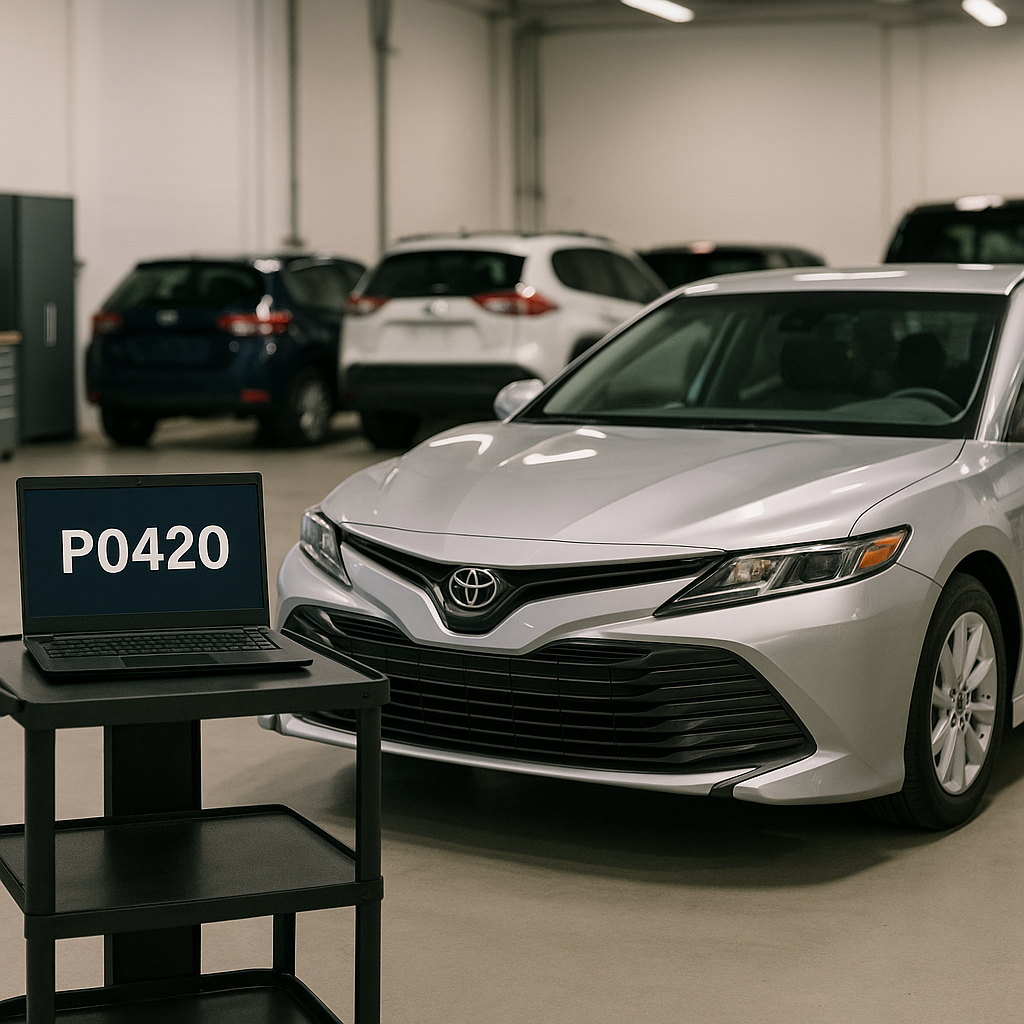
You plug in your OBD2 scanner, and there it is — P0420. Three seconds later you’re down a rabbit hole of conflicting advice, sky-high repair quotes, and forum posts that contradict each other. Let’s cut through all of that right now.
P0420 means your engine control module (ECM) has detected that the catalytic converter on Bank 1 is not cleaning exhaust gases as efficiently as it should. That’s the short answer. The longer answer — including exactly what this means for your Honda Civic, Honda Accord, Toyota Camry, Toyota RAV4, or Ford F-150 — is what this guide covers in full.
Here’s the good news: P0420 does not always mean you need a new catalytic converter. In a meaningful number of cases, the root cause is something cheaper and simpler. This guide walks you through a logical diagnostic process so you spend money on the right fix, not the expensive one that may not even be necessary.
What Is the P0420 Code, Really?
P0420 stands for “Catalyst System Efficiency Below Threshold (Bank 1).” Bank 1 is the side of the engine that contains cylinder number one. On four-cylinder engines like those in the Civic, Camry, and base RAV4, there is only one bank, so Bank 1 is the only bank. On V6 and V8 engines like the F-150’s available engines, Bank 1 is typically the passenger side on Ford applications, though always verify with your specific service manual.
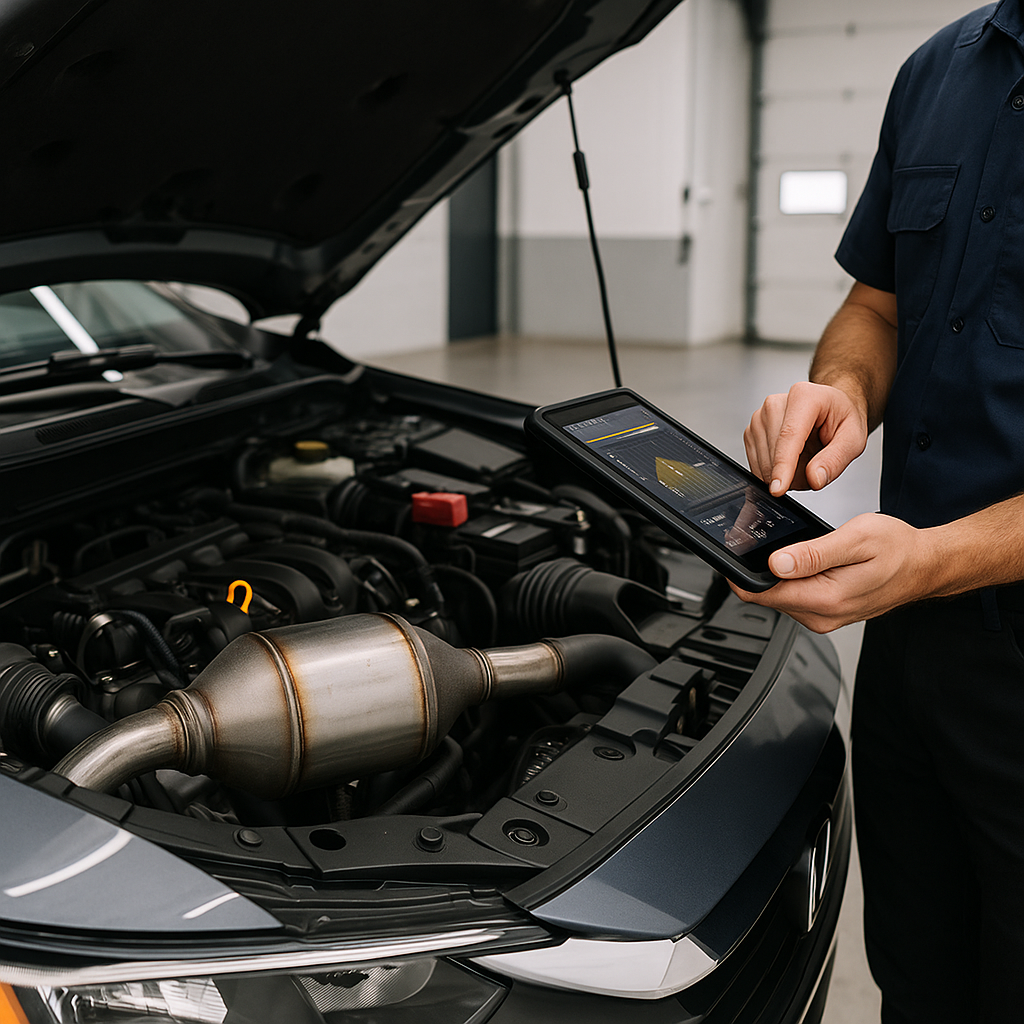
Your car’s exhaust system uses at least two oxygen sensors (O2 sensors) working around the catalytic converter. The upstream sensor (before the cat) measures the oxygen content in raw exhaust gases. The downstream sensor (after the cat) monitors what comes out after the converter has done its job. A healthy catalytic converter oxidizes hydrocarbons and carbon monoxide into water vapor and carbon dioxide, while also converting nitrogen oxides. When it’s working properly, the downstream O2 sensor should show a relatively steady, stable signal compared to the fluctuating signal of the upstream sensor.
When the ECM sees the downstream sensor mimicking the upstream sensor too closely — meaning the cat isn’t changing the exhaust chemistry the way it should — it flags P0420 and turns on the Check Engine Light.
How P0420 Shows Up Differently Across These Five Vehicles
While P0420 is a universal OBD2 code, each vehicle has quirks that make diagnosis and repair slightly different. Here’s what you need to know for each model before you start turning wrenches.
Honda Civic (2006–Present)
The Honda Civic is one of the most common P0420 vehicles seen in forums and repair shops. Civics from the 2006–2011 generation are particularly well-known for this code, and Honda actually released a Technical Service Bulletin (TSB) acknowledging that some of these vehicles had catalytic converters that degraded faster than expected under normal use conditions. The 1.8L R18A engine’s cat is positioned fairly close to the engine, which speeds up thermal aging over high-mileage use.
On the 2012–2015 Civic, another known contributor is the downstream O2 sensor (sensor 2) failing before the cat itself gives up. Replacing just the downstream sensor on these models sometimes resolves the P0420 without any cat replacement at all. Always check sensor function first on a Civic.
For the tenth and eleventh generation Civics (2016–present) with the 1.5L turbocharged engine, oil consumption can contaminate the catalytic converter over time, especially in colder climates where short trips dominate. If your Civic is turbocharged and you’re dealing with P0420 alongside some blue-ish smoke at startup, check your oil level before assuming the cat is simply worn out.
Honda Accord (2003–Present)
The Accord’s P0420 story changes depending on whether you have a four-cylinder or V6 model. The four-cylinder Accord (2.4L K24 engine family) tends to trigger P0420 after high mileage — typically after 120,000 miles or more — with the catalytic converter genuinely reaching end of life. The V6 Accord (3.0L or 3.5L J-series engine) is more likely to trigger P0420 alongside P0430 (Bank 2), since it has two catalytic converters. If you see both codes on a V6 Accord, that’s a signal the entire exhaust system’s converter life may be ending.
A very common and often overlooked cause on the Accord is an upstream O2 sensor that has become lazy — meaning it responds slowly to changes in exhaust composition. A lazy upstream sensor skews the ECM’s comparison data and can fool the system into thinking the cat is failing when it isn’t. Before ordering any parts, confirm both sensors are responding correctly with live data on your scanner.
Toyota Camry (2002–Present)
Toyota Camrys, especially the four-cylinder 2AZ-FE models from 2002–2011, have a well-documented history of excessive oil consumption. When an engine burns oil, the catalytic converter gets coated in oil ash, which physically blocks the honeycomb substrate inside the converter. This is called catalyst poisoning, and it directly causes P0420. If you’re driving a Camry and you’re adding oil between changes, that oil consumption is probably a major contributor to your P0420 code.
The fix here isn’t just a new catalytic converter — if you don’t address the oil consumption first, the new cat will eventually fail too. Check your PCV valve, inspect for valve stem seal wear, and make sure you’re not running low on oil. Toyota did extend warranties on certain 2AZ-FE engines for oil consumption issues, so if your Camry is within a covered range, that’s worth investigating.
For newer Camrys with the 2AR-FE or A25A-FXS hybrid powertrains, P0420 is less common but still occurs. On these models, genuine converter degradation after 150,000 or more miles is the more typical cause.
Toyota RAV4 (2006–Present)
The RAV4’s P0420 presentation is similar to the Camry’s, especially on models sharing the 2AZ-FE four-cylinder engine. The same oil consumption concerns apply. However, the RAV4 is also frequently driven in stop-and-go suburban conditions or used for short trips, which prevents the catalytic converter from reaching its optimal operating temperature. Over time, this “cold cycling” can reduce converter efficiency and trigger P0420 even when the converter itself isn’t catastrophically damaged.
If you only drive your RAV4 short distances, try taking it on a 30–45 minute highway drive at sustained speeds before scanning again. Sometimes P0420 on a short-trip vehicle temporarily clears after the converter gets a proper heat soak and burns off accumulated deposits. That’s not a permanent fix, but it helps you understand whether you have a genuine hardware failure or a usage pattern issue.
RAV4 Hybrid and RAV4 Prime models have a different catalyst setup, and P0420 on these requires a hybrid-aware diagnostic approach. The regenerative braking and engine cycling patterns affect how the ECM monitors catalyst efficiency, and some cases on hybrid RAV4s have been traced to software calibration rather than physical converter failure.
Ford F-150 (2004–Present)
The F-150 is America’s best-selling truck, and P0420 is a code that F-150 owners encounter across multiple engine families. On the 5.4L Triton V8 (2004–2010 era), spark plug issues — including the infamous two-piece plug design that could break during removal — sometimes caused misfires that dumped raw fuel into the catalytic converter, accelerating its failure. If you have an older Triton F-150 with P0420, check for any history of misfires or rough running.
On the EcoBoost F-150s (2.7L and 3.5L turbocharged), oil consumption from turbocharger seal wear can contaminate the converter over time. Additionally, the EcoBoost runs significantly richer during cold starts for emissions compliance, which adds heat stress to the converter. These engines tend to see P0420 after high-mileage use.
Ford has also released several software updates over the years that adjust how the PCM monitors catalyst efficiency. An outdated PCM calibration on an F-150 can cause P0420 to trip even when the catalytic converter is still functioning adequately. Before replacing anything on an F-150 with P0420, check whether there are any open Technical Service Bulletins or software updates for your specific year and engine combination. Many dealerships will apply these updates for free or for a minimal fee during a diagnostic visit.
Step-by-Step Diagnostic Process for P0420
Follow these steps in order. Jumping straight to replacing the catalytic converter without going through this process is how people waste hundreds or even thousands of dollars on parts they didn’t need.
Step 1: Confirm the Code with a Scanner
Your first move is to confirm P0420 is actually present using a proper OBD2 scanner — not just the warning light on your dashboard. Any entry-level Bluetooth scanner paired with a smartphone app or a handheld unit will do this. Write down the exact code, and also note whether it’s a current (active) code or a pending code. A pending code means the ECM has detected the issue but hasn’t fully confirmed it yet. A current code means it has been confirmed across multiple drive cycles.
Also record the freeze frame data if your scanner captures it. Freeze frame shows you engine conditions at the moment the code was set — RPM, coolant temperature, fuel trim, vehicle speed, and so on. This data can point toward cold-start conditions, specific load scenarios, or fuel system issues that contributed to the fault.
Step 2: Check for Related Codes
P0420 rarely tells the whole story on its own. Before doing anything else, look for companion codes. Pay close attention to any of the following:
- P0136, P0137, P0138, P0140, P0141 — downstream O2 sensor circuit faults. If you have one of these alongside P0420, the sensor itself may be the actual problem.
- P0171 or P0172 — fuel trim codes indicating the engine is running lean or rich. A rich-running engine floods the converter with unburned fuel; a lean condition can cause misfires that do the same.
- P0300–P0308 — misfire codes. An active misfire dumps raw fuel into the exhaust and can destroy a catalytic converter in a surprisingly short time. Fix any misfire before addressing the cat.
- P0430 — same as P0420 but for Bank 2. Getting both on a V6 or V8 engine is a strong sign of true converter wear.
If you find misfire codes or fuel system codes, fix those first. Replacing the catalytic converter while a misfire or fuel trim problem is still active is a waste of money — the new cat will fail prematurely for exactly the same reason.
Step 3: Inspect the Catalytic Converter and Oxygen Sensors
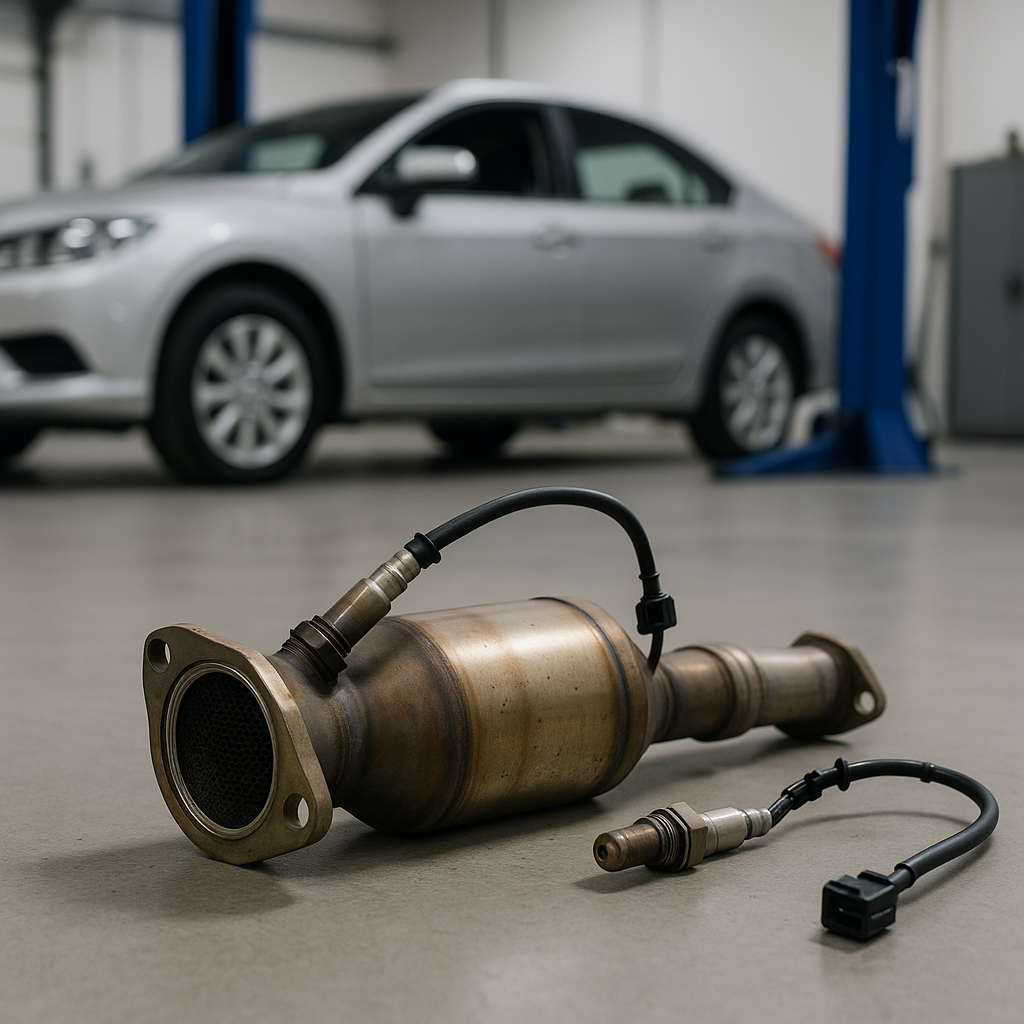
Now it’s time to get under the car. Do a visual inspection of the catalytic converter shell. Look for dents, cracks, or sections where the outer shell has been crushed (common after hitting road debris or a particularly aggressive speed bump). A physical impact can fracture the ceramic honeycomb substrate inside, which will both reduce efficiency and create a rattling sound when you rev the engine.
While you’re under there, give the converter a gentle tap with a rubber mallet or your fist. A healthy converter sounds solid. A failing one with broken internal substrate will rattle — that’s the sound of broken ceramic moving around inside the metal shell. This rattle test is not definitive, but it is a fast way to identify a mechanically destroyed converter.
Next, evaluate your O2 sensors using live data on your scanner. This is critical. Select sensor 1 (upstream) and sensor 2 (downstream) on Bank 1 and watch the live voltage readings while the engine is fully warmed up and running at idle. The upstream sensor should oscillate between roughly 0.1V and 0.9V in a relatively rapid pattern. The downstream sensor should hold relatively steady, typically around 0.6V to 0.8V, with much less oscillation than the upstream sensor.
If the downstream sensor is oscillating just like the upstream sensor, the catalytic converter is not changing the exhaust chemistry — confirming the cat is inefficient. If the downstream sensor shows no movement at all, is pegged low (near 0V), or shows an erratic pattern that doesn’t correlate with engine changes, the sensor itself may be faulty. A bad downstream sensor is a far cheaper fix than a new catalytic converter.
Step 4: Check for Exhaust Leaks
An exhaust leak upstream of the downstream O2 sensor introduces outside air into the exhaust stream. That extra oxygen causes the downstream sensor to read lean, which the ECM can interpret as poor catalyst performance and set P0420 as a result. This is a sneaky cause that many DIYers overlook entirely.
With the engine warm and running, listen carefully for any ticking or hissing sounds near the exhaust manifold, manifold gaskets, front pipe, or the flange connections around the catalytic converter itself. You can also carefully hold your hand near these areas (not touching — exhaust components get extremely hot) and feel for puffs of hot air. Another method is to use an unlit propane torch near exhaust joints — do not ignite it; just use the propane gas flow as a tracer. If engine RPM changes when propane reaches a seam or joint, you’ve found a leak drawing gas in.
Exhaust leaks can sometimes be fixed with clamps, gaskets, or exhaust repair tape for minor cracks — all far less expensive than a catalytic converter. A severely cracked manifold will need professional welding or replacement, but even that is generally less costly than a high-quality catalytic converter on most of these vehicles.
Step 5: Consider Fuel Quality and Recent Maintenance History
This step is often skipped, but it matters. Ask yourself a few questions before moving to repairs:
- Has anyone recently used fuel additives, especially fuel injector cleaners that are not ethanol-safe or that weren’t recommended for your vehicle?
- Was your last oil change done with the correct oil specification? Using the wrong viscosity or non-approved additives can affect how the engine burns fuel.
- Did the P0420 appear shortly after filling up at an unusual gas station? Contaminated or very low-quality fuel can temporarily reduce catalyst efficiency.
- Have you recently had any work done near the exhaust system, where a sensor connector may have been disturbed?
Sometimes P0420 appears as a temporary condition that clears itself after a few drive cycles of running clean fuel and normal operating temperatures. Clear the code after addressing any obvious factors, complete two or three full drive cycles that include highway speeds, and rescan. If it comes back, you have a genuine hardware problem. If it doesn’t, you may have just dealt with a temporary efficiency dip.
Step 6: DIY or Call a Mechanic?
Here’s an honest breakdown of where the DIY line falls on P0420 repairs:
Most DIYers can handle: Replacing an oxygen sensor (upstream or downstream), checking and repairing minor exhaust leaks, replacing a spark plug that was causing a misfire, and doing a PCV valve replacement to address oil burn issues. These are accessible repairs with straightforward procedures available in vehicle-specific repair guides.
Where a mechanic adds real value: Catalytic converter replacement varies significantly in difficulty by vehicle. On a Civic or Camry with a simple bolt-on converter, a mechanically confident DIYer with decent tools can often handle it. On an F-150 with a manifold-integrated converter (common on some EcoBoost configurations), the job is more involved, involves heat shields and tight clearances, and can be significantly harder if the bolts are corroded from years of heat cycling. A professional shop with an exhaust torch and proper lift access will do it faster and with less risk of broken fasteners.
Estimated Repair Costs by Vehicle and Cause
Costs vary based on your location, whether you use a dealership or independent shop, and whether you’re sourcing OEM, aftermarket, or used parts. The following ranges are realistic estimates for parts and labor combined at an independent shop. DIY parts-only costs are typically 40–60% lower.
One important note on California and CARB-compliant states: if you live in California or one of the states that follows California Air Resources Board (CARB) emissions standards, you legally must use a CARB-compliant catalytic converter. Not all aftermarket converters sold online qualify, and using a non-compliant part can result in a failed smog inspection. Always confirm the converter is CARB-compliant if you’re in a regulated state before purchasing.
Common Mistakes People Make When Dealing with P0420
These are the mistakes that cost people the most time and money when dealing with this code. Avoid them and you’re already ahead of most DIYers.
Replacing the Cat First
Jumping to the most expensive fix without confirming the root cause. A bad O2 sensor or exhaust leak costs a fraction of a new converter.
Ignoring Misfire Codes
Active misfires will destroy a new catalytic converter within months. Fix the misfire first, always, before addressing any catalyst-related codes.
Skipping Live Data
A code reader that only shows stored codes isn’t enough. You need live O2 sensor data to tell whether the sensor or the converter is the actual problem.
Using Non-CARB Converters
Installing a non-compliant converter in a CARB state causes smog test failure. Confirm compliance before purchasing any aftermarket catalytic converter.
Using O2 Sensor Spacers
Spacers or signal modifiers for the downstream O2 sensor are a temporary workaround that rarely works long-term and may violate emissions laws in your area.
Not Checking TSBs First
Technical Service Bulletins from Honda, Toyota, and Ford sometimes offer covered repairs or software fixes for P0420 on specific year/engine combinations.
Can You Drive with P0420?
Technically, yes — P0420 on its own does not put your engine in immediate danger. The car will continue to run. However, there are several important reasons not to simply ignore it and keep driving indefinitely.
First, if the root cause is a misfire or fuel system issue rather than a worn converter, continuing to drive can cause additional damage — both to the engine and to whatever new catalytic converter eventually gets installed. Second, in most states, a vehicle with a stored Check Engine Light will fail an emissions inspection, and driving with P0420 means you can’t legally renew registration in many jurisdictions. Third, a severely deteriorated catalytic converter can eventually become a restriction in the exhaust system, reducing engine performance and fuel economy over time.
The bottom line: don’t panic and don’t rush out to spend $1,000 immediately, but don’t ignore P0420 either. Work through the diagnostic steps methodically, and you’ll have a clear answer about what actually needs to be fixed.
OEM vs. Aftermarket Catalytic Converters: Which Should You Buy?
This is one of the most debated topics in the P0420 repair world, so let’s address it honestly.
OEM (original equipment manufacturer) catalytic converters are made to the exact specifications of your vehicle. They fit perfectly, they meet all emissions requirements for your state, and they generally last longer than budget aftermarket options. The downside is cost — OEM converters can be two to three times the price of an aftermarket equivalent.
Aftermarket converters range from excellent to terrible. A reputable brand that makes converters to OEM-equivalent specifications (often called “direct-fit” converters) can perform very well and offer a solid middle ground on price. Cheaper universal-fit converters often require cutting and welding, may not seal as well, and sometimes trigger P0420 again within a year or two because their precious metal catalyst loading doesn’t match OEM specs.
For vehicles like the Honda Civic and Toyota Camry where the converter is a relatively affordable part either way, spending a bit more for a reputable direct-fit aftermarket converter is generally the right call. For the F-150, where converters can get expensive regardless, confirming the root cause first and then choosing an appropriately-specced converter is especially important — you don’t want to repeat this repair prematurely.
When comparing aftermarket options, look for converters with clearly stated precious metal (platinum, palladium, and rhodium) loading specifications, a manufacturer warranty of at least two years, and explicit CARB compliance labeling if you’re in a regulated state.
Frequently Asked Questions About P0420
Will P0420 clear itself?
Sometimes. If the root cause was a temporary condition — like a brief fuel quality issue or incomplete heat cycling — the code may not return after clearing. However, if there’s a genuine hardware problem, P0420 will return within one to three drive cycles. Don’t rely on hoping it clears itself. Diagnose first, then clear the code and monitor.
Is P0420 an emissions failure?
In virtually every state with an OBD2-based emissions test, yes. A stored P0420 code with the Check Engine Light illuminated will cause an immediate failure. Some states have a specific waiver program for cases where repairs exceed a certain dollar threshold, but requirements vary significantly. Check your state’s DMV or emissions authority for waiver specifics.
Does P0420 affect fuel economy?
Indirectly, yes — but usually not dramatically from the code itself. If the underlying cause is a misfire, a lean/rich running condition, or a failing upstream O2 sensor, those problems will affect fuel economy more noticeably than a worn catalytic converter on its own. A degraded converter that has become physically restricted will reduce exhaust flow, which adds backpressure and can measurably reduce both power and economy, especially under load.
Can I use a fuel additive to fix P0420?
Some fuel and exhaust system cleaners claim to restore catalytic converter efficiency by burning off deposits. In cases where the converter is contaminated but not physically destroyed, there is anecdotal evidence that products containing polyetheramine (PEA) run through a full tank of fuel can improve catalyst function enough for the code to clear. However, this is not a guaranteed fix and is not effective on a converter with a broken substrate or complete platinum group metal depletion. Think of it as something worth trying before spending money on parts if your converter is otherwise in acceptable physical condition.
Why does P0420 come back after replacing the catalytic converter?
This is the most frustrating scenario, and it almost always points back to an unfixed root cause. The most common reasons are: an active misfire that was present before the replacement and was not fixed, an engine burning oil that is coating the new converter, a lazy upstream O2 sensor feeding the ECM incorrect data, or an exhaust leak that is affecting downstream sensor readings. If P0420 returns after a new converter is installed, do not replace the converter again — re-diagnose from the beginning, focusing on these specific causes.
Honda Civic vs. Camry — is one more likely to need a new cat?
Both are common P0420 vehicles, but for different reasons. On the Civic, the code frequently traces back to the converter reaching the end of its service life after high mileage, or to a faulty downstream O2 sensor. On the Camry, especially the 2AZ-FE engine variant, oil consumption is the leading culprit. The diagnosis path is the same for both — but knowing the Camry’s oil burn history should prompt you to check oil level and consumption carefully before ordering any parts.
Need More OBD2 Code Help?
Fixopedia covers hundreds of diagnostic trouble codes with the same step-by-step, plain-English approach. Bookmark this guide and explore more repair resources on the site.
Quick Summary and Your Next Step
P0420 is one of the most common OBD2 codes across Honda, Toyota, and Ford vehicles — and one of the most frequently misdiagnosed. Here’s everything condensed into a clear action plan:
- Confirm the code with a scanner and note whether it’s active or pending. Capture freeze frame data.
- Check for companion codes before doing anything else — misfires and fuel trim codes change your entire diagnostic path.
- Inspect the catalytic converter physically — look for damage, listen for rattles, and check the condition of the heat shields and surrounding components.
- Evaluate O2 sensor live data — a misbehaving downstream sensor is often cheaper to fix than the converter.
- Hunt for exhaust leaks — they cause false P0420 triggers more often than people realize.
- Address any underlying issues first — oil burn, misfires, and fuel system problems must be resolved before replacing the catalytic converter.
- Choose parts wisely — OEM or reputable direct-fit aftermarket converters, CARB-compliant where required.
Whether you’re driving a high-mileage Honda Civic that’s earned this code through years of faithful service, a Toyota Camry whose 2AZ-FE has a well-known oil appetite, a workhorse F-150 EcoBoost that’s seen plenty of towing duty, or any of the other models covered here — the diagnostic process is the same. Methodical, patient troubleshooting will get you to the right repair at the right price.
P0420 is not a death sentence for your car. It’s a diagnostic puzzle. Approach it that way, and you’ll come out ahead every time.