This post contains affiliate links.
Few dashboard symbols cause as much confusion as the little car with squiggly lines under it. Part of that is because every manufacturer insists on naming the same system something different. Honda calls it VSA. Toyota calls it VSC. Ford says AdvanceTrac, GM says StabiliTrak. Underneath the badge, they are all doing the same job: comparing what your wheels are doing to what your steering wheel says you asked for, and stepping in when those two disagree.
Knowing which system you have, and more importantly whether the light is flashing or holding steady, tells you most of what you need to know before you ever pick up a scan tool. This guide walks through the terminology, the diagnosis, and the point at which you should stop driving.
What traction control and stability control actually do
These are two related systems that share hardware and usually share a warning light.
- Traction control stops a driven wheel from spinning under power. If you accelerate on wet pavement and one wheel breaks loose, the system pulses that wheel’s brake and cuts throttle until it hooks up again.
- Stability control is the broader system. It adds a steering angle sensor and a yaw rate sensor so the car knows whether it is actually going where you pointed it. If you understeer into a corner or the tail starts stepping out, it brakes individual wheels to pull the car back in line.
Both rely on the same wheel speed sensors your anti-lock brakes use. That shared hardware is why an ABS fault so often lights up the traction control warning at the same time.
Honda VSA vs Toyota VSC: same job, different badge
Honda: VSA, VSA OFF, and “Check VSA System”
Honda’s system is Vehicle Stability Assist, abbreviated VSA. On a Civic, Accord, CR-V or Pilot you will typically see two separate indicators:
- The VSA indicator (car with skid marks). Flashes while the system is actively working. Stays on solid when the system has faulted and switched itself off.
- VSA OFF (the same symbol with “OFF” beside it). This means the system was deliberately switched off, usually by the VSA button near your left knee.
Newer Hondas may also throw a “Check VSA System” text message in the driver information interface. That is not a generic nag; it means a stored fault has disabled stability assist. Our Honda Civic and Accord dashboard warning light guide covers how these indicators interact with the other symbols in the cluster.
Toyota: VSC, TRAC OFF, and VSC OFF
Toyota splits the same functionality across more indicators, which is why Toyota owners tend to be more confused than Honda owners:
- VSC — Vehicle Stability Control, the equivalent of Honda’s VSA.
- TRAC OFF — traction control specifically has been switched off, either by you or by the system.
- VSC OFF — stability control has been switched off.
- The skidding car symbol without text — the system is either active right now (flashing) or faulted (solid).
There is a quirk worth knowing on a Camry, Corolla or RAV4: it is extremely common for the check engine light, VSC light and TRAC OFF light to all illuminate together. That combination usually does not mean three separate failures. It means the engine computer logged a fault, and because stability control depends on being able to cut engine torque, it disabled itself as a precaution. Fix the engine code and all three typically clear. Our Toyota Camry and RAV4 warning light guide goes deeper on that cluster behaviour.
Flashing vs solid: the distinction that matters most
Before you diagnose anything, watch the light for thirty seconds of normal driving.
- Flashing briefly, then going out — the system is working exactly as designed. It found a slipping wheel and intervened. Normal on wet roads, gravel, snow, or hard acceleration from a stop. Nothing to fix.
- Solid and staying on — the system has detected a fault and shut itself down. Your car still steers and brakes normally, but you have no electronic safety net if a wheel loses grip.
- Flashing constantly on dry pavement at steady speed — a sensor is feeding bad data. Treat this as a fault, not as normal operation.
A solid light is not an emergency, but it does change how you should drive. Leave more following distance and take corners more gently, especially in the rain, until it is repaired.
Tools and materials you’ll need
- A scan tool that reads ABS and chassis codes, not just engine codes. This is the big one — most cheap code readers only see powertrain “P” codes and will show nothing at all for a traction control fault. See our OBD2 scanner comparison for tools that read chassis modules.
- A tire pressure gauge
- A digital multimeter (for sensor and voltage checks)
- Jack and jack stands, or ramps
- Basic socket set and a wire brush
- Flashlight
How to diagnose a traction control light, step by step
- Check whether you switched it off. Sounds obvious, but the VSA or TRAC button is easy to catch with a knee or a bag. Press it and see if the light changes. On many cars, holding the button for several seconds does something different from a quick press, so try both.
- Cycle the ignition. Turn the car off, wait a minute, restart. A one-off glitch will often clear. If the light comes back immediately, there is a stored fault.
- Check your tire pressures and sizes. Stability systems compare wheel rotation speeds. A significantly under-inflated tire has a smaller rolling diameter and spins faster than its neighbours, which can look like wheel slip to the module. The same goes for a mismatched replacement tire, a compact spare, or badly uneven tread wear. Correct pressures first; it is free and it fixes more of these than people expect.
- Scan for codes in every module. Pull engine codes and chassis or ABS codes. If you find engine codes alongside the VSC light on a Toyota, fix those first and re-check. A misfire is a common trigger here — see our P0300 random misfire guide if that is what comes up.
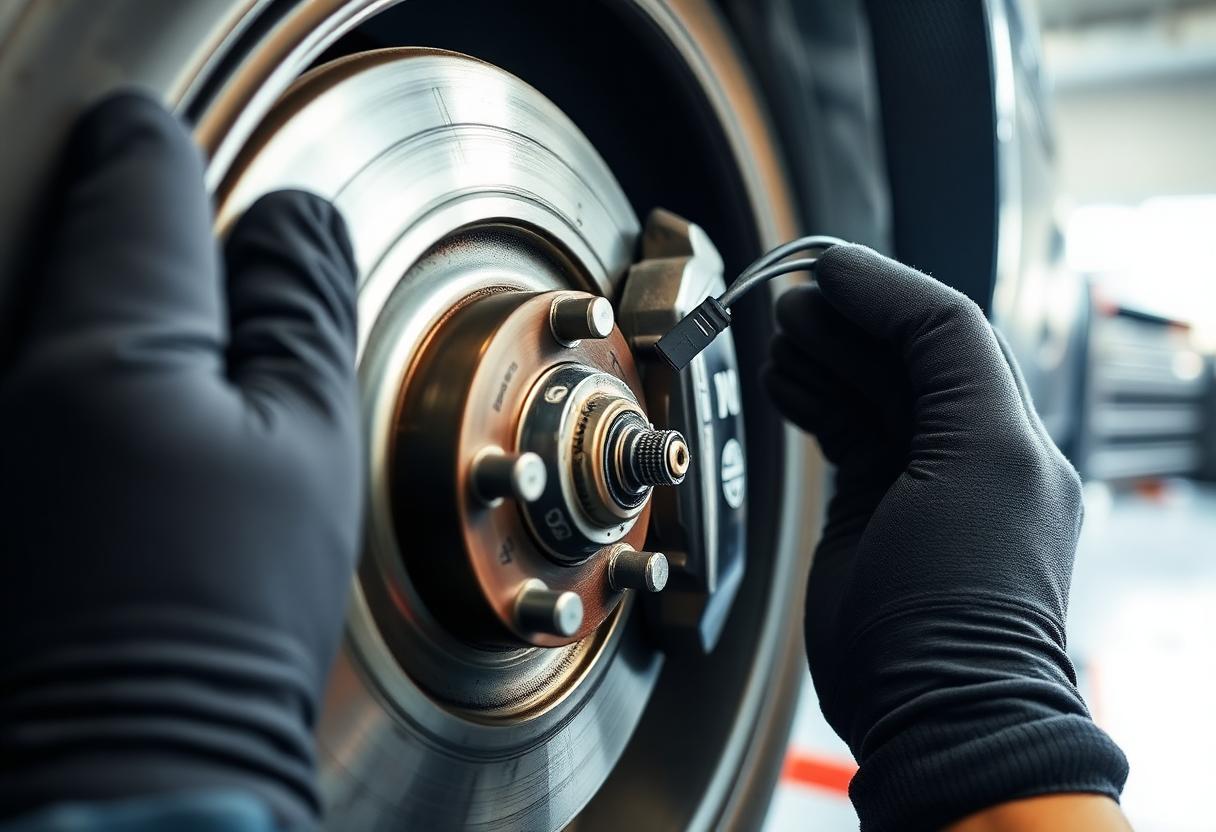
- Inspect the wheel speed sensors. If a code points to a specific wheel, start there. Lift that corner, find the sensor at the hub, and look for a chewed or corroded connector, a wire rubbed through by a heat shield, or a tone ring packed with rust and brake dust. Clean the tone ring with a wire brush and re-check. These sensors sit in the worst possible environment and are the single most common failure point.
- Check the brake light switch. This is a classic on Toyotas. The stability module wants to know when you are braking; a failed switch confuses it. Quick test: have someone watch your brake lights while you press the pedal. If they do not come on, or stay on constantly, replace the switch.
- Check battery and charging voltage. Stability modules are voltage-sensitive and will set faults on a weak or dying battery, often alongside a cluster of other unrelated warnings. Load-test the battery before chasing sensors. Our battery testing guide walks through it.
- Consider the steering angle sensor. If codes point here, note that this sensor usually needs recalibration after an alignment, a steering rack replacement, or sometimes just a battery disconnect. Recalibration is often a scan tool function rather than a parts replacement.
Common mistakes
- Clearing the code and calling it fixed. The light will come back, and you have thrown away the diagnostic breadcrumb that told you which wheel to look at.
- Buying a wheel speed sensor before inspecting the wiring. A large share of these faults are a broken wire or a corroded connector, not the sensor itself.
- Ignoring the check engine light next to it. On Toyotas especially, the engine fault is usually the root cause and the VSC light is a symptom.
- Fitting one new tire on an all-wheel-drive car. The rolling diameter mismatch can set stability faults and, over time, damage the drivetrain.
- Assuming the flashing light is a problem. If it flashes only when you accelerate hard or drive in rain, the system is doing its job.
Frequently asked questions
Is it safe to drive with the traction control light on?
For short distances in good weather, generally yes. Your brakes and steering are unaffected. What you lose is the automatic intervention that catches a skid before you feel it. In rain, snow or ice, that is a meaningful loss of margin, so get it diagnosed promptly and drive conservatively until then.
Why did my VSC and check engine light come on together?
Because stability control needs to be able to reduce engine torque to work. When the engine computer logs a fault it cannot be sure it can do that reliably, so it disables the system. Diagnose the engine code first; the VSC light usually clears with it.
Can bad wheel alignment cause the traction control light?
Alignment itself rarely triggers it directly, but an alignment often involves moving the steering wheel position, which can leave the steering angle sensor out of calibration. If the light appeared right after an alignment, ask the shop to recalibrate the sensor.
Should I just turn traction control off?
Only in specific situations, such as rocking a car out of deep snow or mud where you actually want wheel spin. Otherwise leave it on. Switching it off to make a warning light go away hides the fault without fixing it, and removes a system that measurably reduces loss-of-control crashes.
When to call a professional
Stability control is a safety system, and some of its work is genuinely beyond a driveway repair. Hand it to a shop if:
- The codes point to the ABS or stability control module itself rather than a sensor
- The steering angle or yaw rate sensor needs recalibration and you do not have a bidirectional scan tool
- The traction control light appears together with a solid brake warning light — that combination can indicate a hydraulic brake problem and warrants stopping and getting the car inspected before driving further
- You have replaced the obvious sensor and the fault returns
- Any work would involve opening the hydraulic brake circuit, which requires proper bleeding
Parts costs for a wheel speed sensor are usually modest, while module-level work is considerably more, though prices vary widely by vehicle and region. Getting a proper diagnosis before authorising parts is almost always the cheaper path.